Every major AI coding tool now ships a plugin format. That race is over.
Claude Code → Plugin. Gemini CLI → Extension. GitHub Copilot → Agent Plugin. OpenAI Codex → Plugin.
Same idea. One install. Skills + MCP servers + agents — bundled and versioned.
The format was the easy part.
The Format Converged
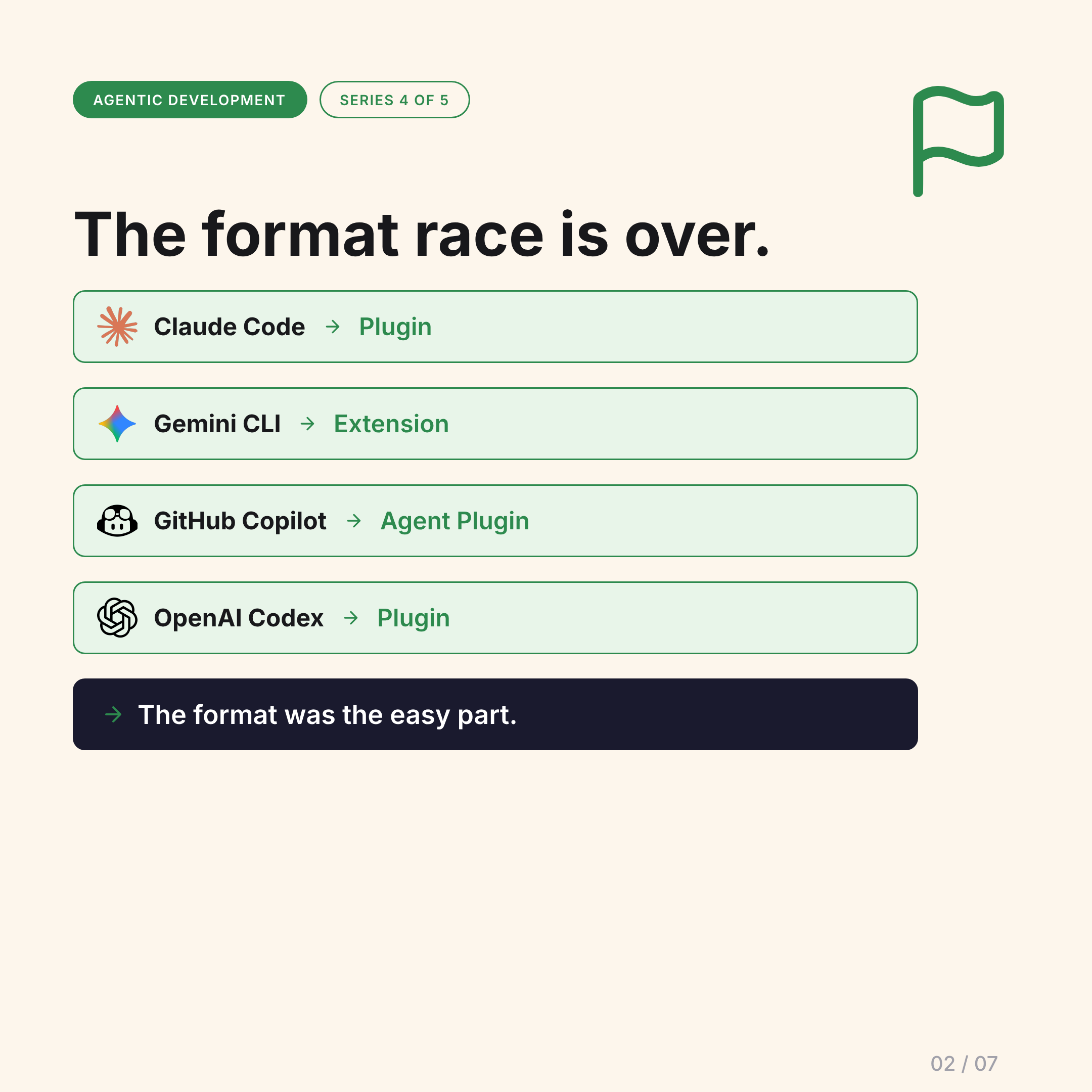
All four tools shipped a plugin format by early 2026. The spec is similar enough that the concept transfers: install a plugin, get skills + MCP connections + hooks as a unit.
But “same format” doesn’t mean “same capability.” The contents of what a plugin can include — and the controls an organization has over what gets installed — vary significantly.
The Capability Matrix
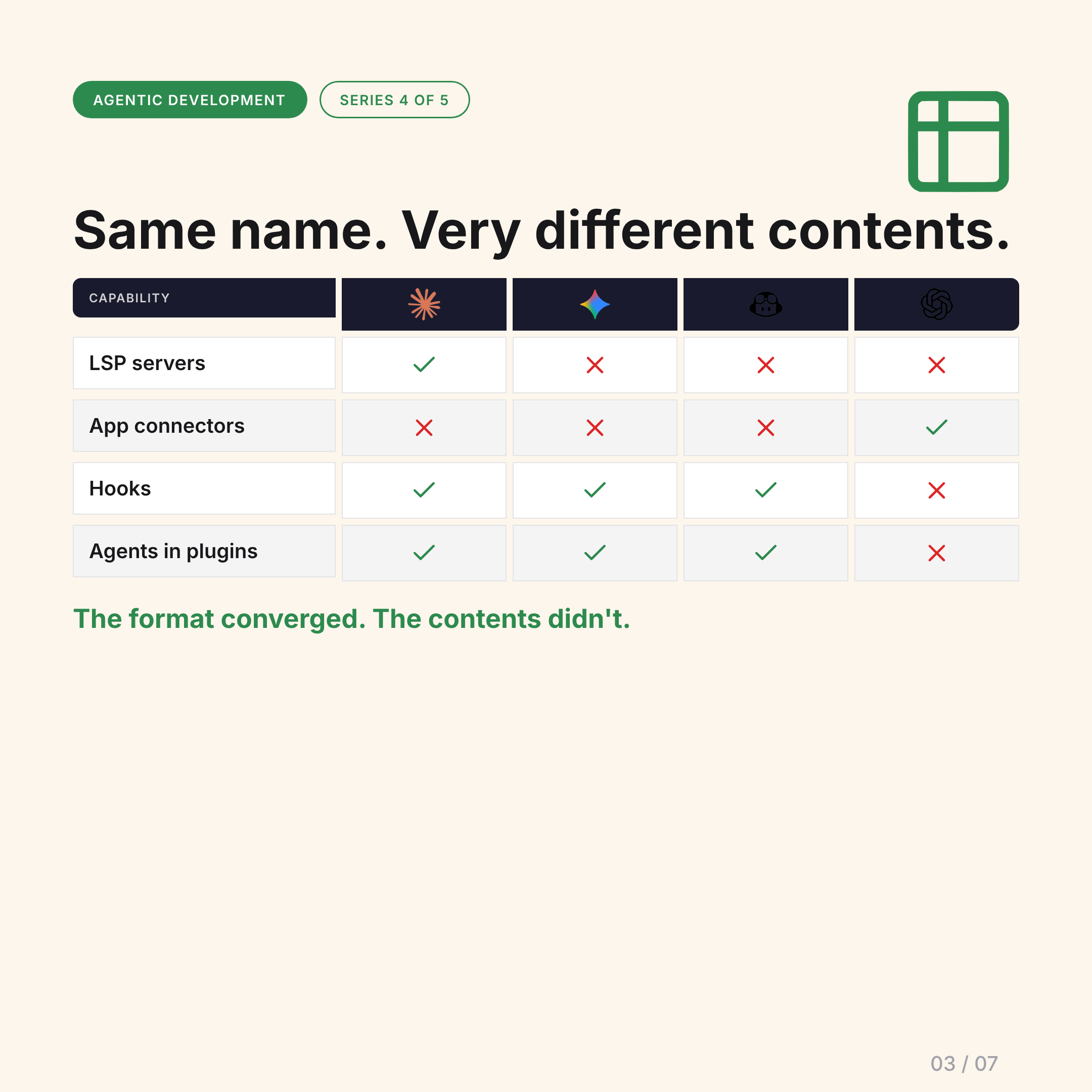
Same plugin concept. Very different contents.
LSP servers (live code diagnostics):
- Claude Code: ✓ Yes
- Copilot: ✗ No
- Gemini CLI: ✗ No
- Codex: ✗ No
App connectors (Slack, Figma, Linear):
- Claude Code: ✗ No
- Copilot: ✗ No
- Gemini CLI: ✗ No
- Codex: ✓ Yes
Lifecycle hooks:
- Claude Code: ✓ Yes
- Copilot: ✓ Yes
- Gemini CLI: ✓ Yes
- Codex: ✗ No
Agents inside plugins:
- Claude Code: ✓ Yes
- Copilot: ✓ Yes
- Gemini CLI: ✓ Yes
- Codex: ✗ No
The format converged. The contents didn’t.
The Differentiators
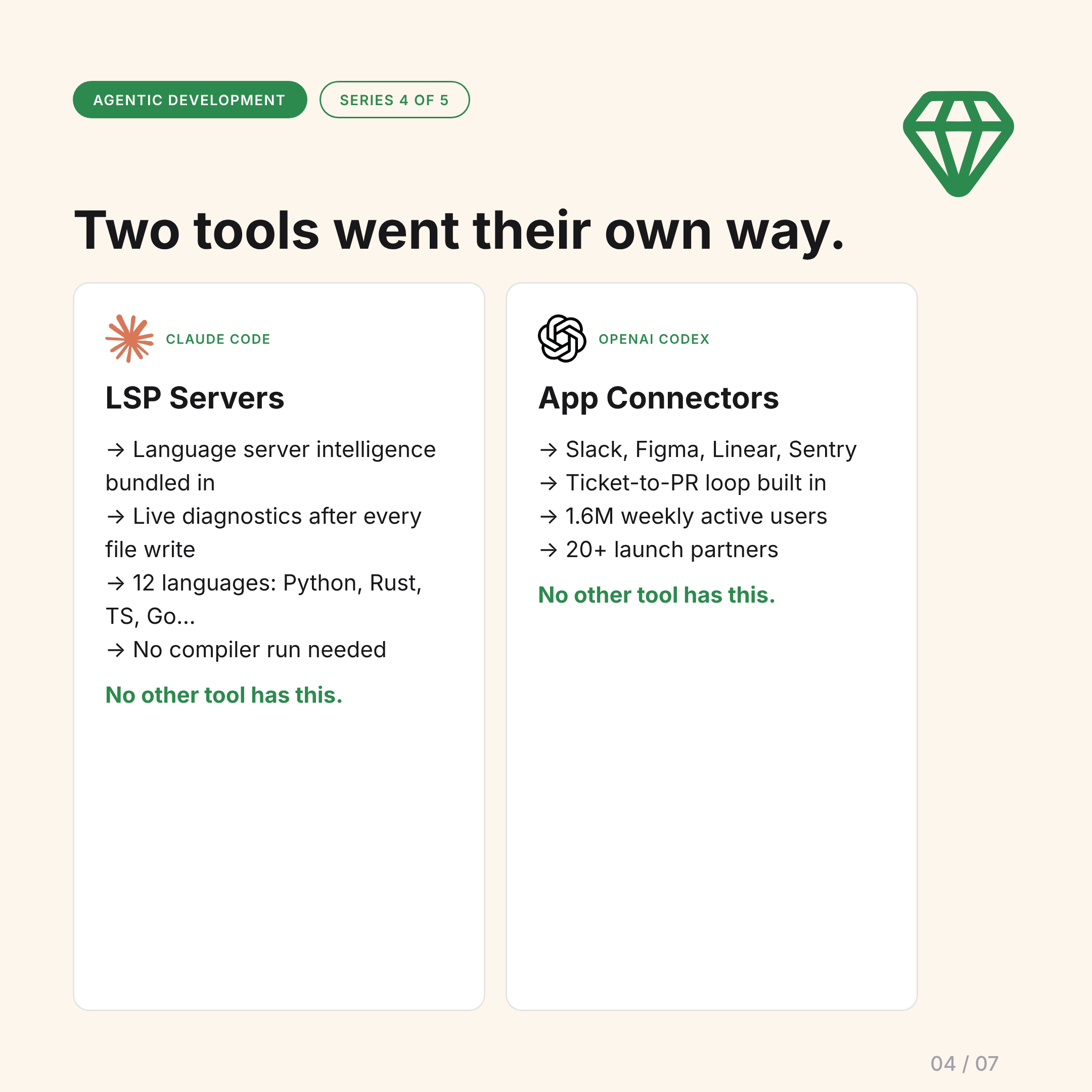
Each tool went its own direction on one capability no other tool has.
Claude Code — LSP servers inside plugins: Bundles language server intelligence directly into a plugin. Live diagnostics after every file write, no compiler run needed. 12 languages: Python, Rust, TypeScript, Go, Java, C#, and more. No other tool has this.
Codex — App connectors: Not just MCP — managed remote connections to Slack, Figma, Linear, Sentry. The ticket-to-PR loop: read a Linear issue → implement → mark done autonomously. 1.6M weekly active users, 20+ launch partners. No other tool has this.
Enterprise Governance
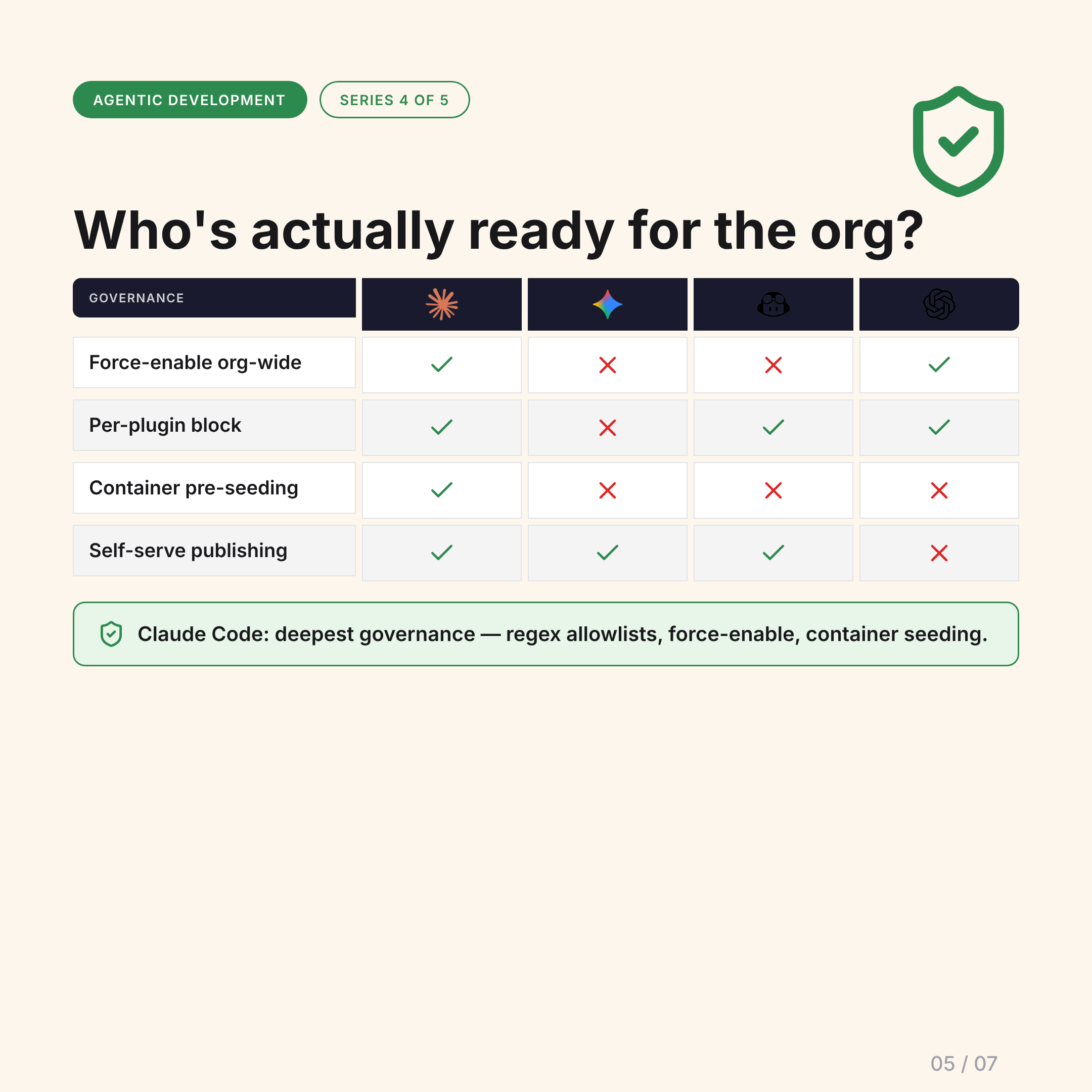
The governance question: who controls what gets installed at the organization level?
Force-enable plugins org-wide:
- Claude Code: ✓
- Copilot: ✗
- Gemini CLI: ✗
- Codex: ✓
Per-plugin blocking (NOT_AVAILABLE policy):
- Claude Code: ✓
- Copilot: ✗
- Gemini CLI: ✓
- Codex: ✓
Container/CI pre-seeding:
- Claude Code: ✓ via SEED_DIR
- Copilot: ✗
- Gemini CLI: ✗
- Codex: ✗
Self-serve plugin publishing:
- Claude Code: ✓
- Copilot: ✓
- Gemini CLI: ✓
- Codex: ✗ (coming soon)
Claude Code has the deepest governance: regex allowlists, force-enable for the entire org, container seeding for CI environments. Copilot currently offers feature-level toggles only with no per-plugin controls.
The Copilot Pivot
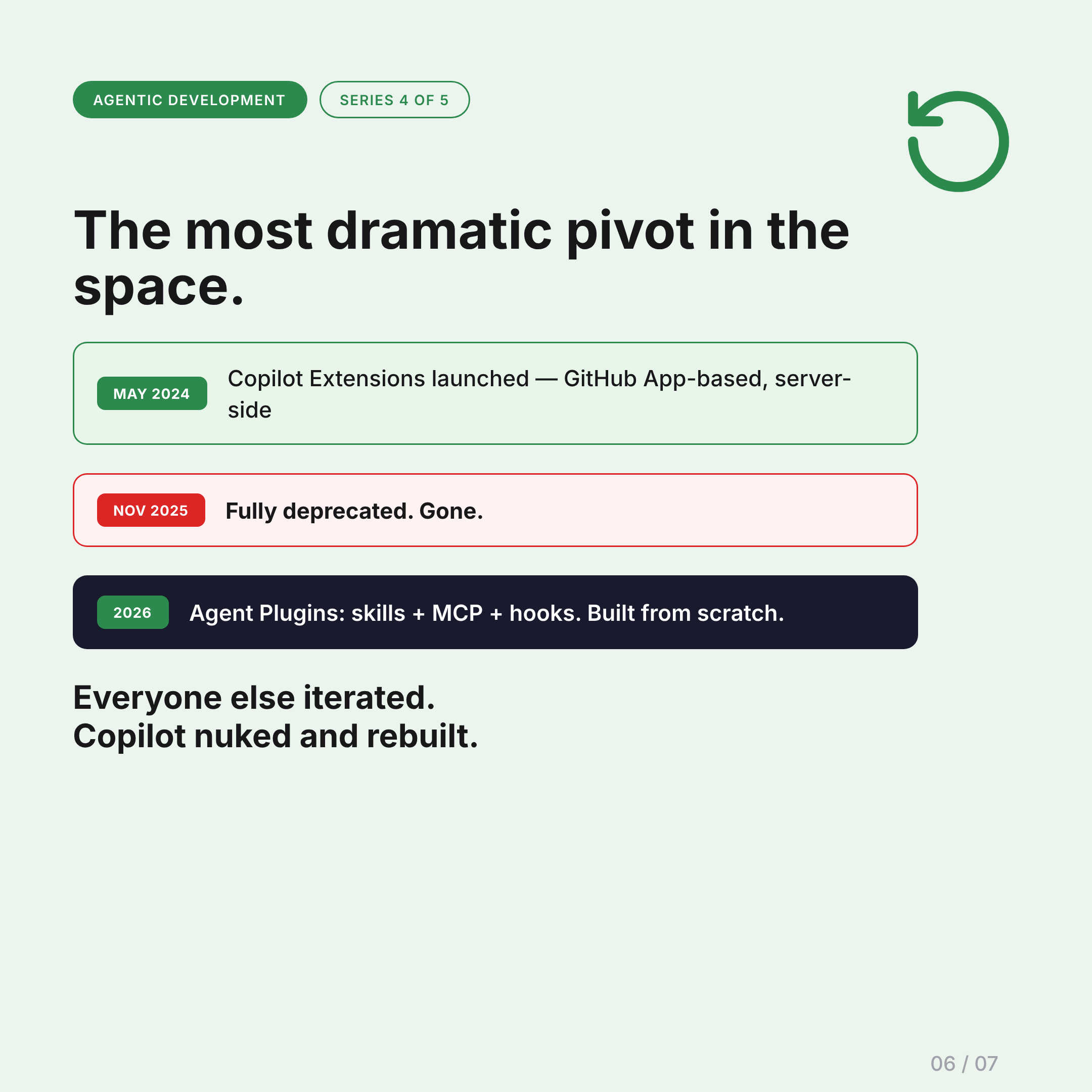
The most dramatic move in the space:
- May 2024 — Copilot Extensions launched (GitHub App-based, server-side)
- November 2025 — Fully deprecated. Gone.
- 2026 — Agent Plugins: skills + MCP + hooks. Built from scratch.
Everyone else iterated on their existing model. Copilot nuked theirs and rebuilt. Agent Plugins are still in preview. The governance depth isn’t there yet, but the architecture is sound.
The Takeaway
The plugin format was the easy win. Every tool has it now.
The gap that matters is threefold:
- What’s inside the bundle — LSP servers vs app connectors vs hooks. Each tool made a different bet on what developers need most.
- Who controls what gets installed — governance depth varies by an order of magnitude. This is the enterprise decision point.
- Whose marketplace is worth building on — the distribution network compounds over time.
Picking a plugin-enabled AI tool is a governance decision as much as a capability one.
The AI Basics #4. Next: MCP Deep Dive