You gave your AI agent a markdown file with rules. CLAUDE.md. GEMINI.md. AGENTS.md.
It worked. Until it didn’t.
One file can’t hold project conventions, deployment workflows, review checklists, and security policies without becoming a wall of text nobody maintains. You needed something modular.
Enter: Agent Skills.
The Problem
A single markdown file with all your agent instructions has a natural ceiling. It gets long. It becomes inconsistent. Different workflows conflict. You stop updating it because touching it breaks something else.
The pattern that emerged: separate the instructions by task. Each task gets its own file, its own scope, its own rules.
The Folder
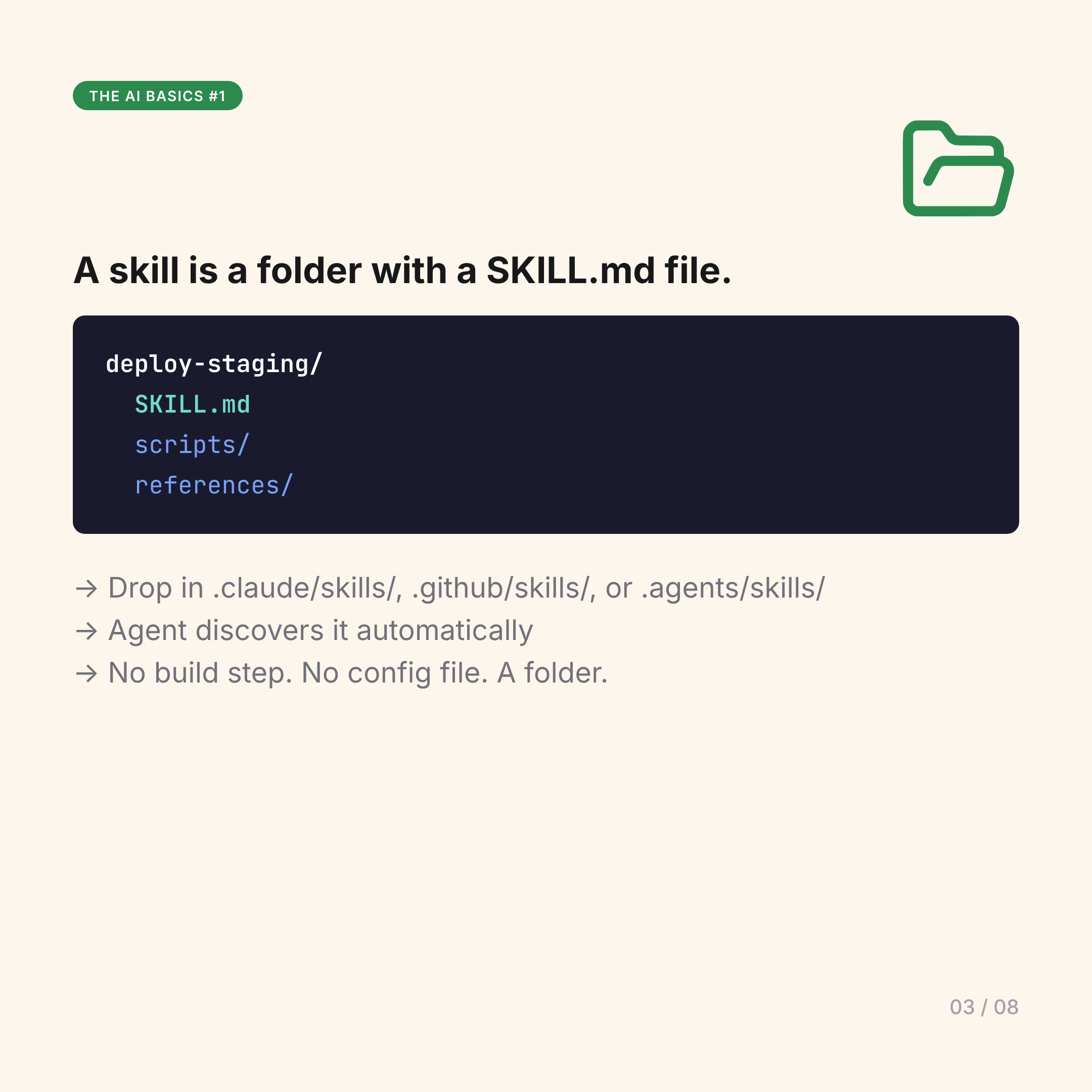
A skill is a folder with a SKILL.md file inside:
deploy-staging/
  SKILL.md
  scripts/
  references/
Drop it in .claude/skills/, .github/skills/, or .agents/skills/. Your agent discovers it automatically at startup.
No build step. No registration. No config file to update. A folder.
The Frontmatter
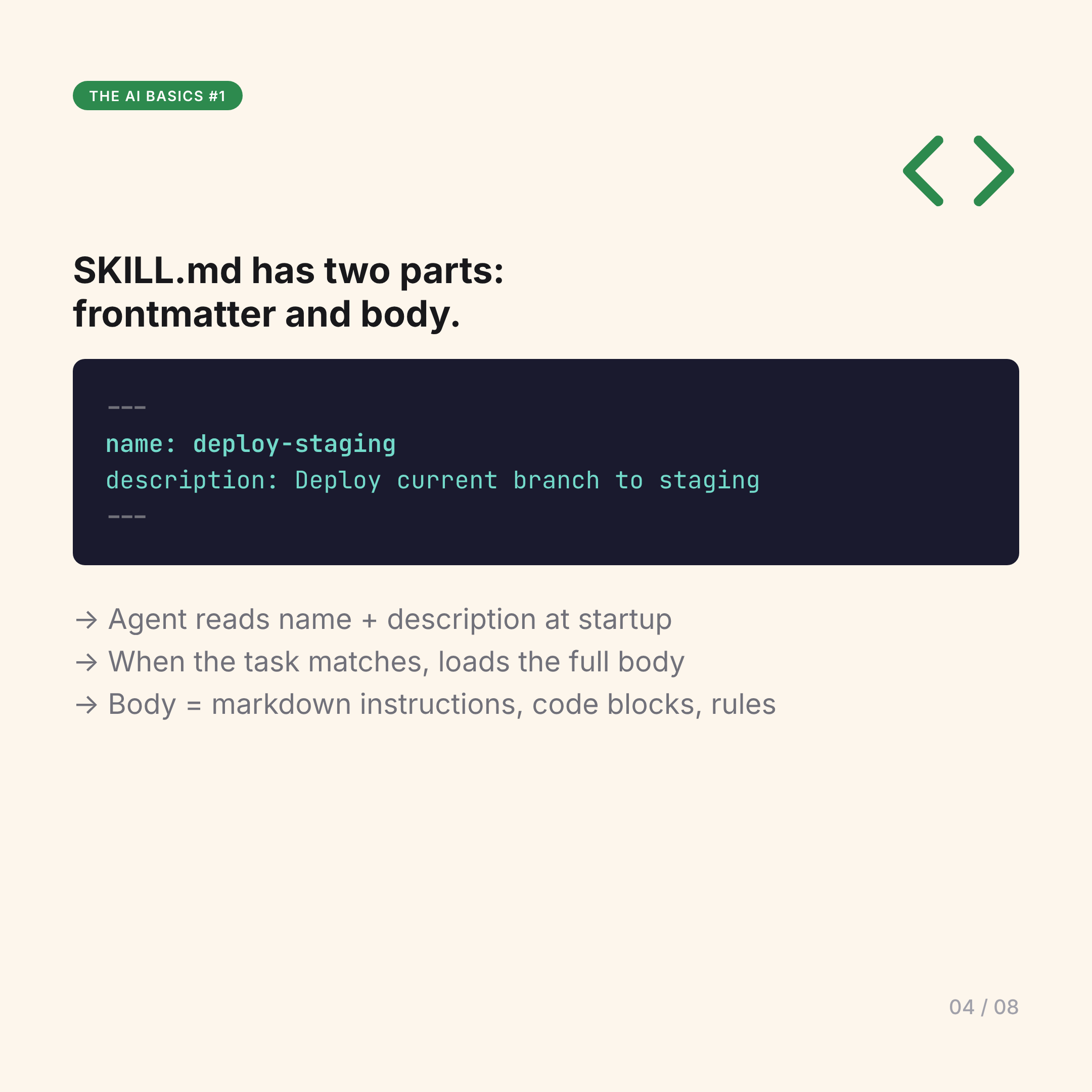
SKILL.md has two parts: frontmatter and body.
---
name: deploy-staging
description: Deploy current branch to staging
---

## Instructions

Run `npm run build` first, then deploy to the staging environment...
The agent reads name and description at startup to understand what the skill does. When a task matches the description, it loads the full body — markdown instructions, code blocks, rules, anything you need.
The Evolution: From Instructions to Governance
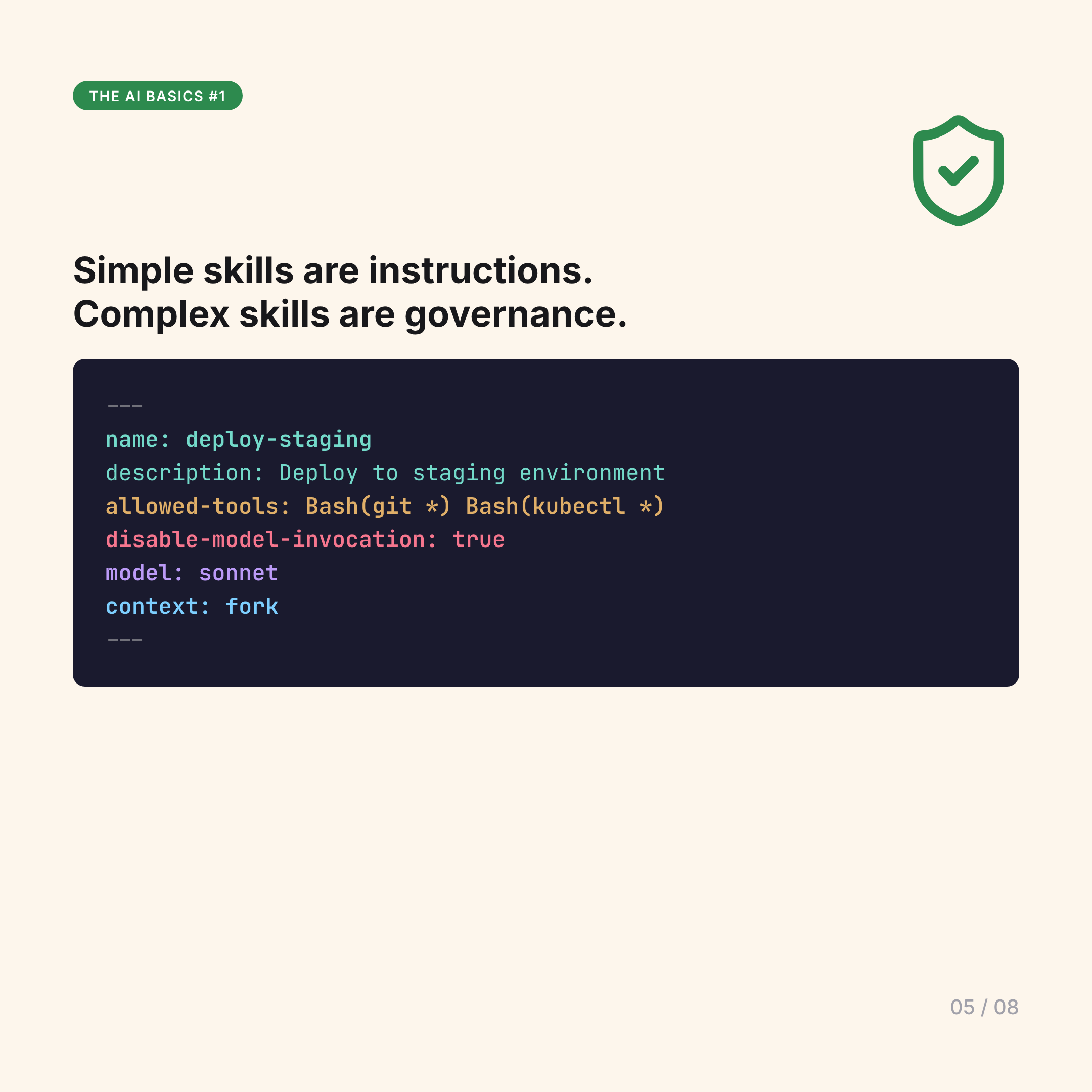
Simple skills are just instructions. Complex skills are governance documents.
---
name: deploy-staging
description: Deploy to staging environment
allowed-tools: Bash(git *) Bash(kubectl *)
disable-model-invocation: true
model: sonnet
context: fork
---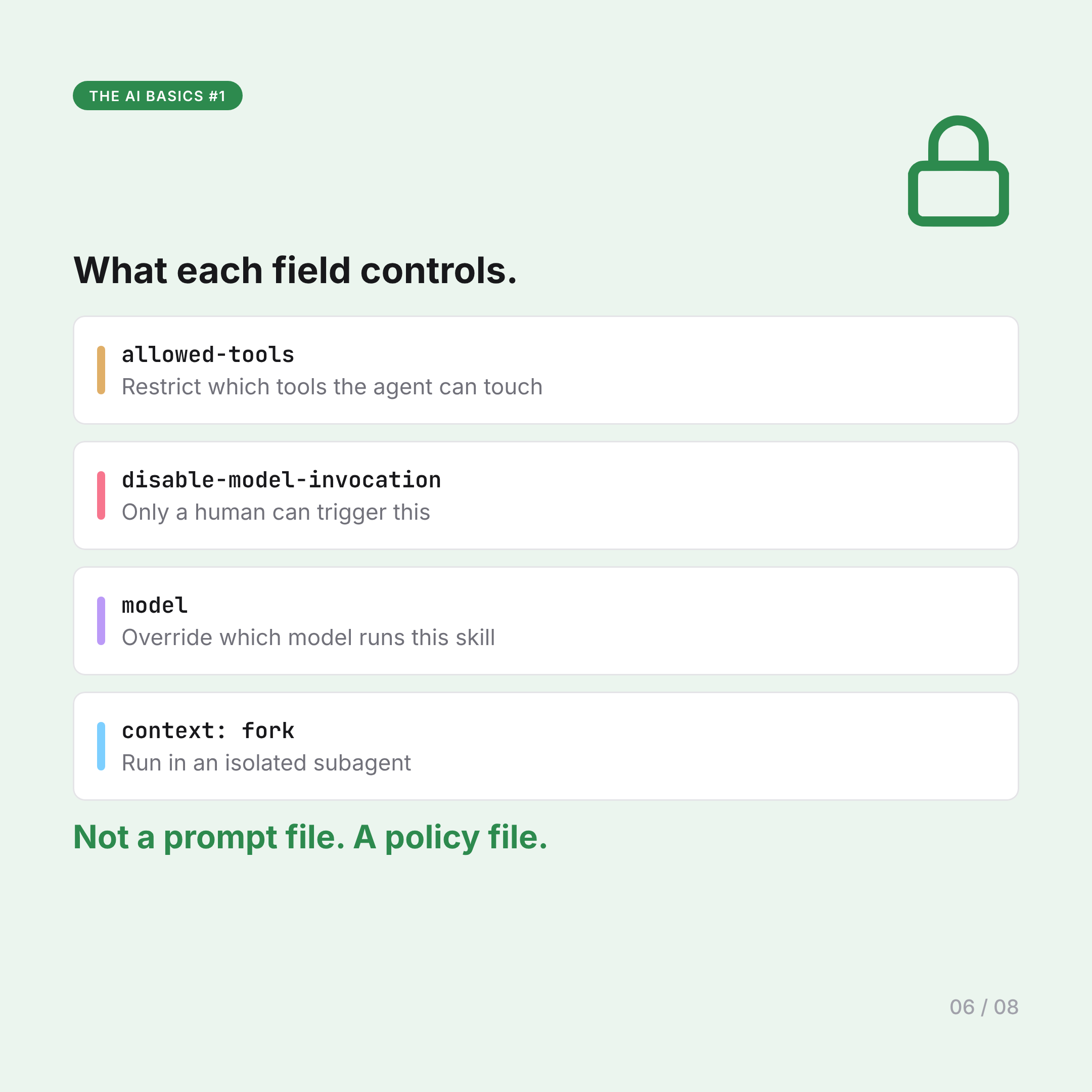
What each field does:
allowed-tools— restrict which tools the agent can use when running this skill. This skill can run git and kubectl commands, nothing else.disable-model-invocation— only a human can trigger this skill. The agent can’t auto-invoke it.model— override which model runs this skill. Use a fast model for simple tasks, a more capable one for complex reviews.context: fork— run in an isolated subagent that can’t affect the parent session.
A skill went from “here are some instructions” to a full access control document.
The Standard
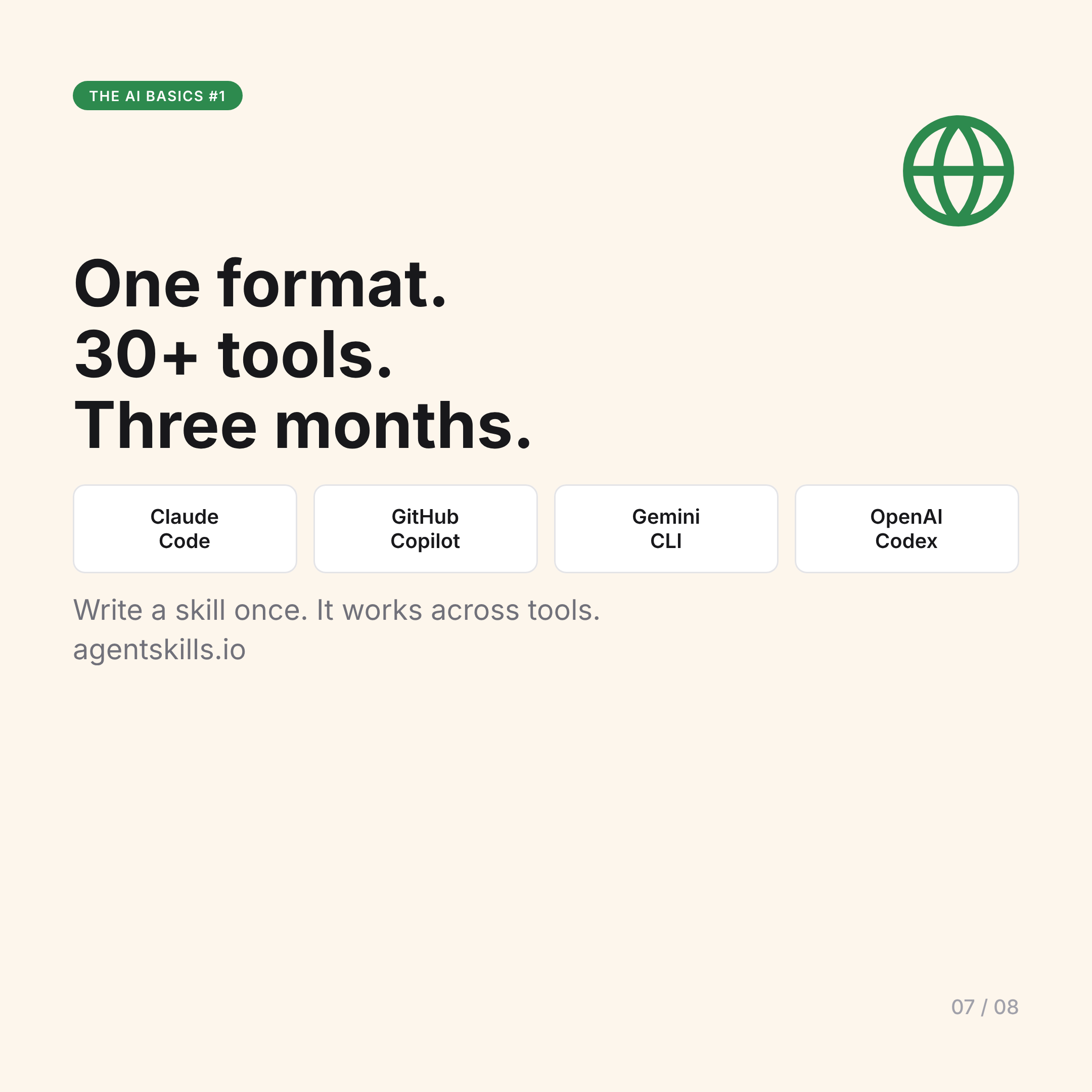
Anthropic published the Agent Skills spec in December 2025. By March 2026, Claude Code, GitHub Copilot, Gemini CLI, and OpenAI Codex all support SKILL.md.
Write a skill once. It works across tools.
Three months from spec to cross-industry adoption is fast. The format converged because the problem was identical across all four ecosystems — everyone needed a way to give agents scoped, modular instructions that scale past a single markdown file.
What’s Next in This Series
The format converged. What diverged is everything else: governance depth, orchestration power, marketplace ecosystems, and what “supported” actually means in practice for each tool.
The next posts in this series cover:
- #2 — Skills Won. Now What? — where the four tools diverge after adopting the same format
- #3 — What Are Plugins? — the layer on top of skills: skills + MCP servers + hooks as a distributable unit
- #4 — State of Plugins — capability and governance comparison across all four tools
- #5 — MCP Deep Dive — the open protocol, the four different config formats, and the governance gap
The AI Basics #1. LinkedIn post